


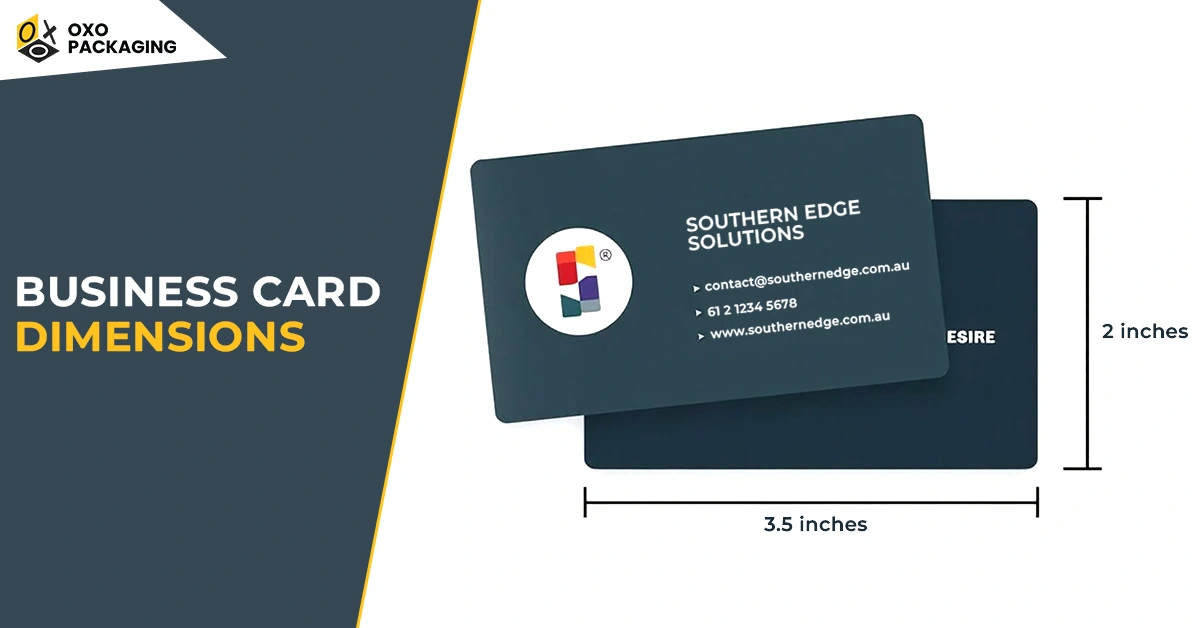
Business cards are a stylish way to leave a lasting first impression on your customers. These cards are designed to introduce your profile in a nutshell. You can craft your business card dimensions in a variety of styles, shapes, and sizes. Before we explain the styles and shapes of business cards, it is better to explain the business card dimensions.
Read this blog to learn what business card dimensions suit best for your specific requirements.
What are the Dimensions of a Business Card?
Business card dimensions are measured by the width and height of the card. The height of the business card is measured along the y-axis, whereas the width is measured along the x-axis. The following are the details of business card sizes according to their specific shapes, sizes, and styles.
Business Card Size at a Glance
The right business card size depends on the country, card style, and how the card will be used. In Australia, 91 × 55 mm is a commonly used standard size. Square, slim, rounded-corner, and custom die-cut cards can use different dimensions.
For printing, always distinguish between the finished card size, bleed area, and safe area. This prevents important text or logos from being trimmed during production.
Popular Business Cards: Dimensions and Styles
Business cards, along with your other packaging essentials, like boxes, labels, and stickers of countless styles and shapes, can enhance your brand image. These products can leave a lasting impression alongside your business cards. The dimensions can vary depending on the shapes and styles of these cards.
Let’s explore a few of the unlimited options of business card sizes in cm according to their shapes and styles. Consider the following specific business card dimensions for your business:
Standard Business Cards
Standard business card dimensions are usually considered to be 90mm x 55mm in Australia. 90mm is the width of the cards, and 55mm is the height of the business cards. Or it can also be stated as 1075 pixels x 650 pixels.
Sometimes these business card dimensions in mm may slightly vary, such as 89 mm x 51 mm or 3.5 inches x 2 inches, or 1050 x 600 pixels. However, it is pertinent to consider these slight variances in the standard dimensions of business cards in Australia.
Square Business Cards
Usually, business card dimensions for a square shape come in 2 inches x 2 inches or 600 pixels x 600 pixels. Square business cards are a stylish way to present your business and yourself to your customers. These business cards carry the same width and length on both axes, the x-axis and y-axis.
Standard business card sizes in Australia can vary from custom business card dimensions. Custom sizes and styles can increase the persuasive appeal to your customers. You can influence them to keep you in their minds and help them order your products to fulfil their business requirements.
Slimline Business Cards
Wondering how big a business card is for a slimline shape and style? Business card dimensions for slimline business cards may also vary according to custom requirements. These cards are slim and a bit tall compared to standard business cards. Due to their distinctive shape, you can instantly notice they are different and attractive. Usually, slimline cards are created with 90mm x 45mm.
Sometimes these cards are produced with 86mm x 50mm, or 3.4 x 2.0 inches. These cards are easy to keep in the wallet because they can fit in the wallet and can be used at the time of need.
Rounded Corner Business Cards
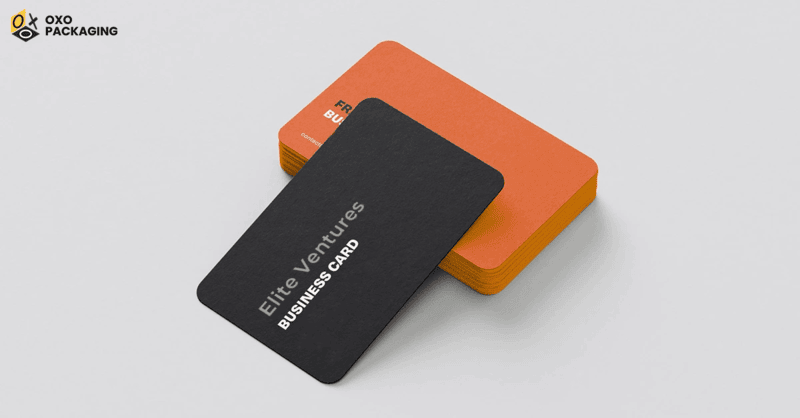
Most business cards are designed with rounded edges to create an amazing look. You can use these business cards to avoid scratches and wear and tear compared to straight-edge business cards. Usually, these rounded-corner business cards have the same dimensions as Aus business card sizes.
Business Card Dimensions in Different Countries
Business card sizes are not identical worldwide. If you serve international customers, check the preferred size for your target market before preparing the artwork. Common reference sizes include:
|
Region |
Common Business Card Size |
|
Australia/Oceania |
Common Business Card Size |
|
North America |
88.9 × 50.8 mm (3.5 × 2 in.) |
|
Europe |
85 × 55 mm |
These are common standards rather than mandatory dimensions. Printers may offer additional custom sizes and shapes.
Get Custom Business Cards for a Personalised Look
What is the size of the visiting card? To know exactly, you need to consider different aspects of the dimensions of custom cards. Regardless of what sizes and shapes of the standard card sizes and dimensions, endless customisation is available depending on your choice. Consider some of the popular shapes and styles to customise your business card dimensions in width and height. Let’s view some of the distinctive shapes here:
Round Shape
Round-shaped business cards are popular among customised business cards for different businesses. Business card dimensions for this type of card may also vary as per the requirements and preferences of business owners like you. Generally, the dimensions of a business card for the round shape style are sized at 2.5 inches in diameter.
Die Cut Business Cards
Die cut business cards are excellent for communicating your business nature and the products of your business. What is the size of a business card? Answering this question is highly important to know before you can craft your business cards in entirely different shapes and styles. Some of the die cut custom business card shapes may include, but are not limited to, the following:
- Coffee Cup Business Cards
- House Business Cards
- Donuts Shaped Business Cards
- Half Circle Business Cards
- Transparent Business Cards
Transparent business cards are an attractive and stylish presentation of your business to your customers. You can impress your customers with the distinguished styles of presentation of your business. These styles of business cards can help your customers think of your creativity and uniqueness in producing your products.
Folded Business Cards
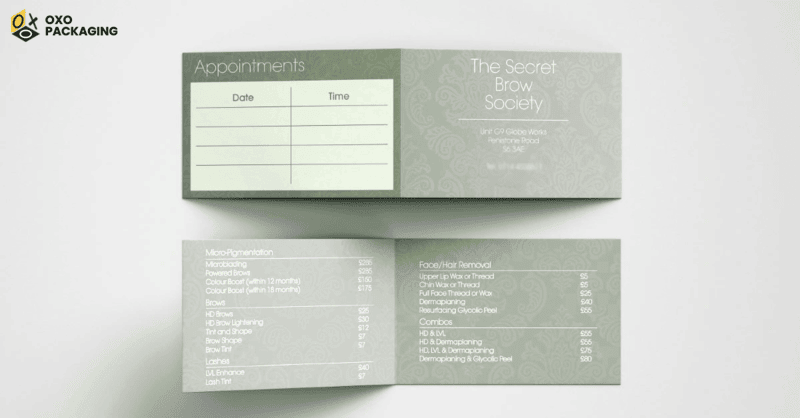
Simple yet stylish business cards can communicate more effectively with a minimalistic design. However, sometimes you need to share more information with your small business cards in a persuasive style. Business card specifications can easily be fulfilled with these folded business cards are a helpful source of producing the required objective for your business
A lot more styles are available to craft your business cards effectively. With the simple size of a visiting card, you can think of your business presentation with your business cards; you can create with endless customization options in styles and designs.
Matte Vs. Glossy Business Cards
If it’s your first time with a business card, you may even be stuck on selecting which finishing option to choose from. For instance, the matte finish is ideal if you want to deliver a subtle impression about your business, and it also represents sophistication and a minimalistic approach.
Whereas, for businesses that target a general audience, a glossy finish is ideal for them as it is welcoming and connects with most of the client’s persona. If still unsure, it’s better to consult a packaging expert to discuss these concerns in detail and get a tailored solution.
Portrait vs. Landscape Business Cards
Business card dimensions do not determine orientation. A 91 × 55 mm card can be designed horizontally or vertically. Landscape cards provide a familiar layout for contact details, while portrait cards can create a more distinctive presentation. Choose the orientation that gives your logo, name, contact details, and other essential information enough space without making the card feel crowded.
How to Choose the Right Business Card Size
Choosing a business card dimension is easier when you consider how the card will be used:
For everyday networking:
Choose a standard wallet-friendly size such as 91 × 55 mm.
For creative brands:
Square or custom die-cut cards can create a more distinctive shape.
For minimal designs:
Slim cards can provide a clean appearance while using less space.
For detailed information:
A folded business card provides additional printable space without making the closed card much larger.
For international networking:
Check the common card dimensions in your target market before printing.
Matte Vs. Glossy Business Cards
If it’s your first time with a business card, you may even be stuck on selecting which finishing option to choose from. For instance, the matte finish is ideal if you want to deliver a subtle impression about your business, and it also represents sophistication and a minimalistic approach.
Whereas, for businesses that target a general audience, a glossy finish is ideal for them as it is welcoming and connects with most of the client’s persona. If still unsure, it’s better to consult a packaging expert to discuss these concerns in detail and get a tailored solution.
Understanding Different Dimensions
Before we move further into the final conclusion of our discussion, it is better to clarify the different aspects of sizing business cards. The following are the different but integral requirements of producing the perfect business cards in sizes:
Bleed Size
Bleed size embraces the wider area of the business card edges to provide better printing and finishing results. Business card dimensions contain the same width and height as the bleed size of the business cards to produce the best fit to the exact requirements. This area is almost 3 mm wider than the trim size of the business cards, say 94mm x 58mm.
Trim Size
Trim just means cutting off the card, and business card dimensions are the same as already discussed in this blog, i.e., 91mm x 55mm or vice versa. The dimensions of business cards usually take trim size as the base. This area is the inner side area of the bleed size of business cards and the outer side of the safe margin size of the business cards.
Safe Margin Size
The difference between the trim size and the safe margin size of the business card is almost the same as the difference between the bleed size and the trim size. It means the safe margin size should be 88mm x 52mm, using the same base of 91mm x 55mm, the trim size area of the business card. The purpose of defining this area is to keep the printed text or image within this limit to perfectly produce your business cards.
Other dimensions for different customised shapes can change as per the same ratio as we have in the standard business card dimensions.
or image within this limit to perfectly produce your business cards.
Things to Consider When Choosing the Business Card Dimensions
When it comes to choosing the dimensions of your business card, you need to keep the following elements in mind. Making the best use of these elements can help your business stand out in the market. Have a look at them:
Optimised Space
Leave an appropriate white space on your card without leaving too much text. Doing so will make your competitors fight for your reader’s attention. Eventually, it may turn off your reader, and your messaging point can’t stand out.
So, ensure a consistent and stunning final product by adopting an optimised space approach. Cover 94mm x 58mm for the bleed area, 91 x 55 mm for the trim area, and 88mm x 52mm for the safe margin area. Even though these dimensions will vary according to the size of your business cards, you will need to consider them as a standardised approach when designing business card dimensions in Australia.
Branding Content
The information printed on business cards is the crux of your brand messaging and marketing effort. Underestimating the importance of highlighting your crucial brand elements may undermine your branding efforts and waste money.
To avoid this, follow the proven content publishing methodology of big brands, which they apply to their business cards. Mentioning crucial brand elements optimised to a given space changes the game for your business. Your name and job title, business name and logo, website and email address, and telephone number are among these elements.
Design and Layout
Ensure you serve your reader with the best design and layout on your business card. Elevate your presentation game by highlighting your brand elements, such as logo and brand game, in premium finishes such as gloss, matte, and spot UV.
Standard Business Card Dimension Chart
|
Standard |
Rounded Corner |
Square |
|
Bleed 91 x 53 mm 3.6 x 2.1 in |
Bleed 91 x 53 mm 3.6 x 2.1 in |
Bleed 66 x 66 mm 2.6 x 2.6 in |
|
Trim 88 x 50 mm 3.4 x 2 in |
Trim 88 x 50 mm 3.4 x 2 in |
Trim 63 x 63 mm 2.5 x 2.5 in |
|
Safe area 85 x 47 mm 3.3 x 1.8 in |
Safe area 85.4 x 47.3 mm 3.3 x 1.8 in |
Safe area 60 x 60 mm 2.3 x 2.3 in |
Common Business Card Dimension Mistakes to Avoid
Avoid these common mistakes when preparing your business card artwork:
- Using the wrong finished size: Confirm the printer's trim dimensions before starting your design.
- Forgetting bleed: Extend background colours, images, or patterns into the required bleed area.
- Placing text too close to the edge: Keep essential information inside the printer's safe area.
- Adding too much information: Prioritise the details customers are most likely to use.
- Designing without checking the physical card: Review a proof or sample before ordering a large quantity when possible.
- Ignoring orientation: Check whether your design is intended for horizontal or vertical printing.
Conclusion
To produce attractive, persuasive, and effective business cards, you need to focus on the business card dimensions. After carefully reading this blog, you are now in a position to know the importance and calculate the exact measurements of different card dimensions for your business.
The sizes of business cards vary depending on the requirements of the buyer. However, the standard size that meets most needs is 3.5 inches by 2 inches.
To measure business card dimensions accurately, you need to define the shape first. If you go for regular rectangular cards, measuring the length and width of the cards will help you get an accurate volume. You can use an inch tape or a ruler to measure these dimensions.
Thicker cardstock or vinyl are two of the most exclusive materials you can use to create luxurious and robust business cards. These materials are famous for their endless printing opportunities, customisability, and longevity.