


How to Choose the Perfect Cereal Box Dimensions for Your Product?
Waqas Khan Pitafi 2025-07-14 12:43:08
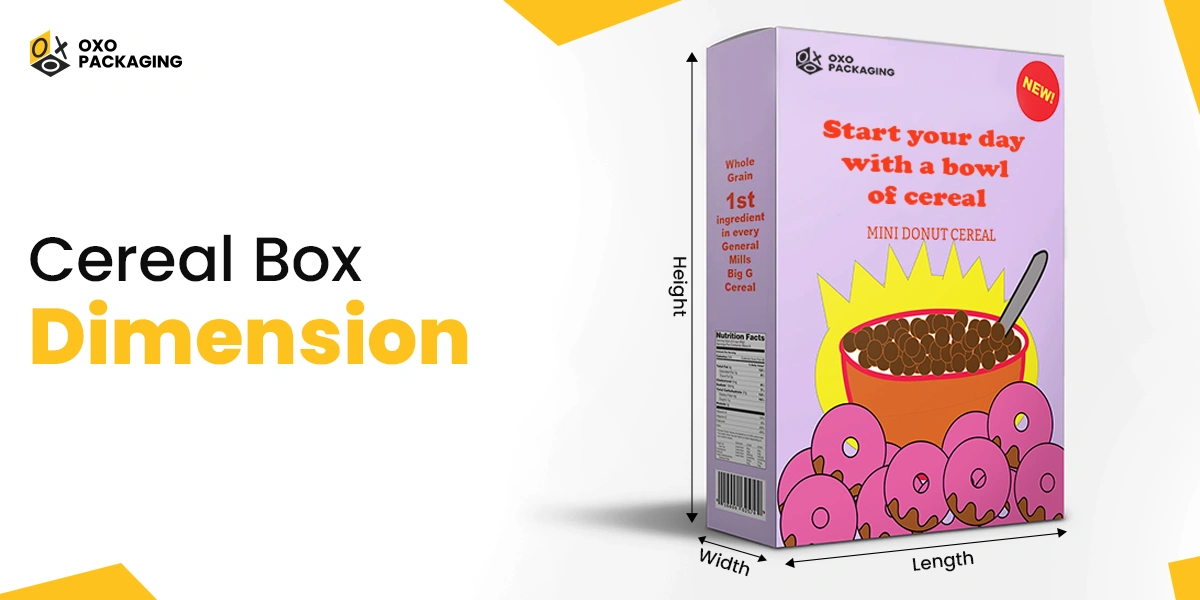
Choosing the right dimensions for cereal packaging boxes is paramount to perfectly packing the portion of cereals. But the question that arises here is how you can select and measure the accurate sizes of your cereal packaging boxes that meet your needs.
In this blog, we will explore how to choose the perfect cereal box dimensions for your product and measure them proficiently without errors. Read on to find more!
Importance of Cereal Box Dimensions
Whether you are looking for breakfast cereal boxes or corn flakes packaging, the significance of cereal box dimensions always remains undeniable. Suitable dimensions of the custom packaging boxes allow you to fit the portions of your cereal accurately without hassle.
Shelf space optimisation is another plus you get if you customise your boxes in the right dimensions. We know that retail shelves have a limited space. Accommodating your products in optimal quantity such that they grab the attention of potential buyers is essential for your business. And choosing the right box style can help you do so.
Appropriate dimensions of your cereal box packaging also offer customer convenience. If your box size is appropriate, your buyers will easily consume your cereals far before your products expire.
Optimising the quantity of cereals inside your packaging boxes according to the consumption habits of your target audience can help you manage your manufacturing and supply chain. And choosing the optimal volume of your cereal packaging boxes helps you with this.
Here's How to Choose the Perfect Cereal Box Dimensions for Your Product!
Now that we know the importance of cereal box dimensions, let’s explore the various aspects defining the ultimate size of a packaging box. Here are the dimensions that you should consider irrespective of what style of cereal boxes you choose:
Length, Width, and Height of Cereal Boxes
The length, width, and height of a custom box define its size and volume. Measuring these dimensions is important if you want to make a perfectly sized box for your cereal products. You can use a meter ruler or measuring tape to measure these box dimensions.
The standard unit for measuring these dimensions is inches, yet you can also go for other size units like centimeters. When documenting the size of your cereal packaging boxes, make sure to write in this format to avoid confusion:
Length × Width × Height
L × W × H
Volume of Cereal Box Packaging
Once you’ve accurately measured the length, width, and height of your cereal boxes, you can calculate the volume without any worries. The fundamental formula for calculating volume with these dimensions is as follows:
Volume = Length × Width × Height
V = L × W × H
The unit of the volume depends on the dimensions. For instance, if you’ve measured length, width, and height in centimeters, the unit of volume would be cubic centimeters.
Measuring the volume of your packaging boxes is highly important because it helps you define the quantity of cereals you need to pack in the boxes.
Key Point: Avoid filling the cereals compactly inside the box! Spare some space to keep cereals pristine.
Weight of Cereal Packaging Boxes
Weight is one of the most important aspects of custom box dimensions. It assists you in the convenient shipping of your cereals, as the shipping services charge you per weight of your products.
Weight is the aspect of cereal box dimensions that you can’t accurately calculate. You need to measure it with the help of a weighing machine. You can choose standardised material and dimensions for all your required boxes that will help you calculate the weight of a single piece when you weigh in bulk.
How to Measure the Dimensions of Cereal Box?
To measure the dimensions of a cereal box, flatten it and place it on the level surface to ensure accurate measurement. Then, follow standard formula (L × W × H) to measure length, width, and height with the help of measuring tape or meter ruler:
- Measure the length of your cereal box from one end to the other.
- Measure width by tracking the shortest side of the box, which is perpendicular to the length.
- Measure the side of your cereal box that is perpendicular to both length and width.
You can measure these dimensions in both inches and centimeters.
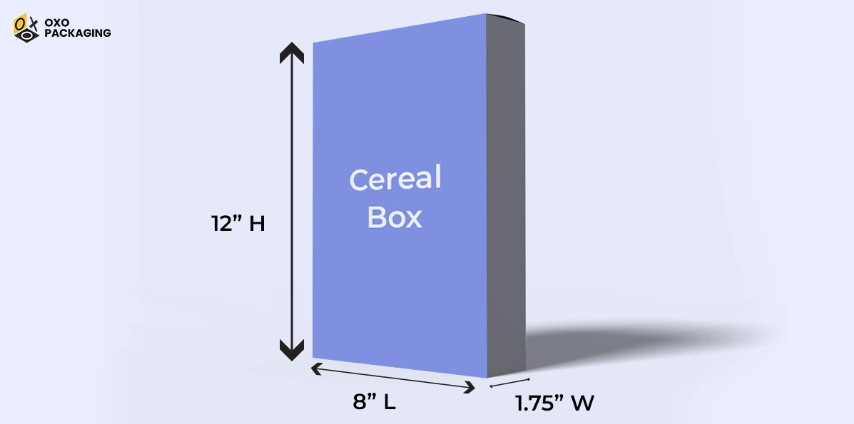
Standard Sizes of Cereal Box Packaging
Choosing a standardised size is one of the fundamental aspects of an effective cereal box packaging. The actual size of your cereal boxes depends upon the quantity of cereals you want to pack in these boxes. However, some standard sizes for small, medium, and large cereal boxes are listed here:
- Length 20 to 30 centimeters, or 8 to 12 inches.
- Width 5 to 7.5 centimeters, or 2 to 2 inches.
- Height 12 inches to 14 inches, or 30 and 35 cm.
- Weight 17 to 20 ounces.
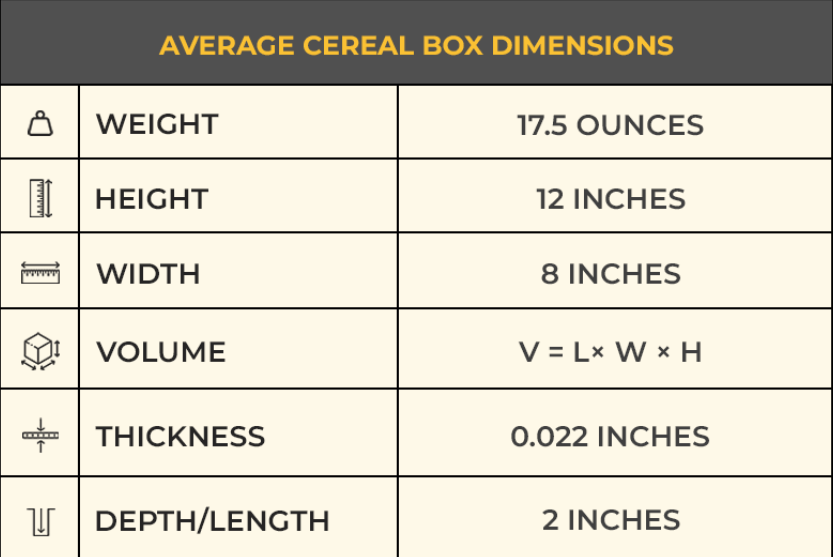
Essential Elements to Consider Before Manufacturing Cereal Boxes
After taking measurements of boxes, it is important to consider the following three aspects to avoid blunders after your packaging has been manufactured in bulk:
Content Volume Calculation For Snug Fit
The need for space inside the box may vary depending on the type of cereal, which requires unique styles of cereal boxes. For example, if you’re selling puffed or flaked cereals, the thin and flat flaky texture needs more space in the box than the grainy and shredded texture. That’s why it’s important to calculate dimensions to help ensure the following benefits:
- There’s adequate space for the inner liner
- The cereal fit snuggly without any movement
- Eliminate the misconception of an oversized box that appears full but is not
- Maintain product integrity during shipping
Considering Effective Materials
Material efficiency is a crucial consideration in cereal box dimensions because it directly impacts production costs, logistical efficiency, environmental benefits, and sustainable packaging for brands. Optimising dimensions helps balance practical needs with cost control and consumer perception. The ideal materials that ensure all these requirements are:
- Cardboard paper is recyclable, sturdy, lightweight and allows excellent printing.
- Paperboard is lightweight and recyclable, but it can harm the cereal's integrity due to the thin paper construction.
- Kraft paper is another excellent choice for preserving quality, eliminating carbon footprint and leveraging premium branding.
Structural Integrity Consideration
The dimensions of a cereal box are strategically designed to balance box structural integrity, market needs, logistics, storage, handling and consumer convenience. Here’s what you need to ensure:
- Boxes that provide stability on shelves and during stacking
- Avoid shallow boxes that are prone to crushing or collapsing during transit.
- Ensure the depth of boxes is balanced so that they carefully hold product and avoid material waste.
- The average thickness of cardboard boxes is 0.022 inches (0.05588 cm), which is considered standard thickness in cereal boxes for adequate box integrity.
Where to Customize Cereal Packaging Box Dimensions?
Customising cereal box dimensions from a reputable custom packaging company is paramount. This is because such reliable companies pay good attention to the quality of your packaging and the accuracy of its size as well.
If you are looking for such a reputable supplier, you can reach out to OXO Packaging, the top packaging supplier all over Australia. All you need to do is share your packaging requirements with us.
Grab premium quality boxes that not only pack your cereals perfectly inside but also persuade your customers to buy them. Reach out to us and benefit from free shipping all over Australia.
Conclusion
This is it, measuring the right box dimensions for your cereal packaging won’t be an uphill task for you now! This blog has covered all the aspects of choosing and measuring appropriate cereal boxes for your products.
However, if you are still confused about the size or design of your cereal packaging boxes, reach out to us and we will answer your queries. You can also get a quote from us for accurately sized high-quality cereal boxes for your products.
Standard cereal boxes are approximately 12 inches tall, 7.5–8 inches wide, and 2–3 inches deep, holding about 10–14 oz of product. Larger family-size boxes can be 14–16 inches tall and hold up to 24 oz.
Measure the product’s height, width, and depth, then add 1–2 inches for internal packaging (liners, padding, sealing space). Choose a box that fits snugly to reduce shipping costs and prevent damage.
Proper dimensions help you:
-
Reduce shipping weight and costs
-
Protect product integrity
-
Meet shelf-space requirements
-
Improve branding and visual impact
-
Comply with retail packaging guidelines
A height-to-width ratio of 1.6:1 is commonly used for cereal boxes in retail, making them tall enough for visibility and slim enough for shelving efficiency.
Yes. Mini boxes (4–5" wide × 7–10" tall) are used for single-serve, trial packs, or hotel & travel kits, especially in portion-controlled or snack formats.
Absolutely. Choose recyclable kraft paperboard, soy-based inks, and minimal plastic liners to create an environmentally responsible product package.