
Whether you are a business in food service, publishing, manufacturing or global trade, knowing millilitre-to-cup conversions matters. Converting millilitres to cups helps you translate international recipes, label product packaging, and ensure accurate manufacturing quantities.
So read this blog in detail to know everything about millilitres-to-cups conversion and never lag in accurate measurement.
Why Does Millilitres to Cups Conversion Matter?
Put simply, conversion from millilitres (mL) to cups bridges the gap between the metric system and US customary units. It prevents cooking and baking failures caused by incorrect liquid or volume proportions.
A US cup is roughly 236.6 mL, while metric cups used in some regions equal 250 mL. Mixing these standards up ruins recipes. Here is how millilitres (mL) to cups conversion plays an important role across different industries:
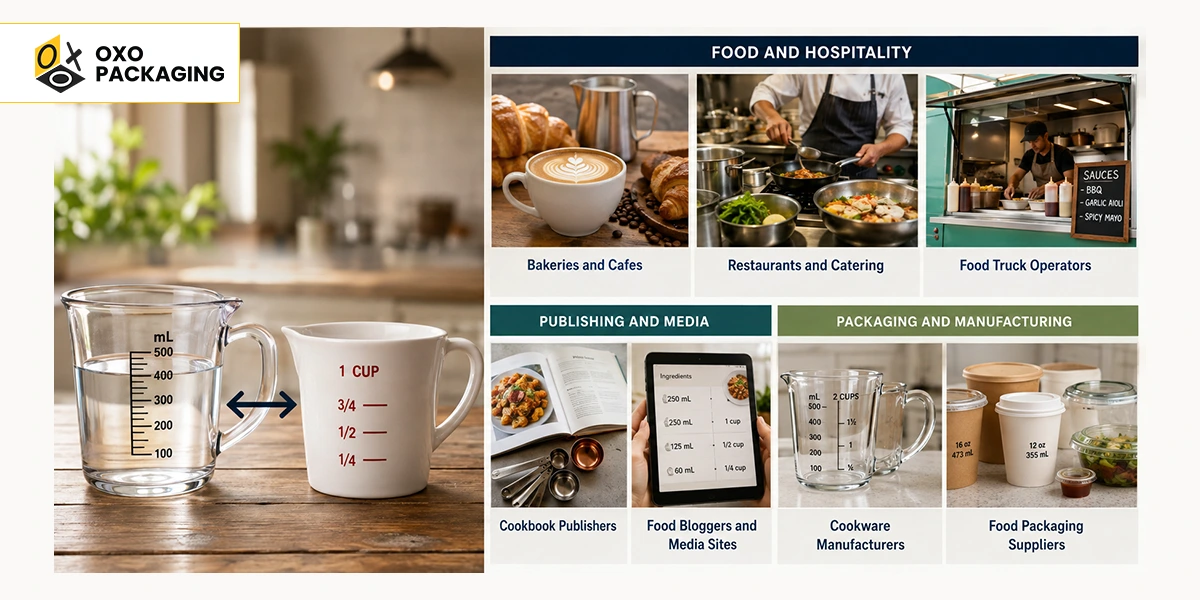
Food and Hospitality
- Bakeries and Cafes: Adjust international baking and coffee formulas that switch between metric liquid volumes (mL) and volumetric cups.
- Restaurants and Catering: Scale recipes up or down when shifting between supplier specifications in millilitres and kitchen prep tools scaled in cups.
- Food Truck Operators: Standardise portion sizes and sauces when sourcing ingredients from different regional markets.
Publishing and Media
- Cookbook Publishers: Adapt recipes for international audiences where the US uses customary cups (~237–240 mL) and other regions use metric cups (250 mL) or millilitres.
- Food Bloggers and Media Sites: Provide accurate ingredient cards that automatically convert fluid metrics for global website visitors.
Packaging and Manufacturing
- Cookware Manufacturers: Design measuring cups, jugs, and kitchen tools with dual metric (mL) and customary (cup) volume lines.
- Food Packaging Suppliers: Produce disposable cups, takeout bowls, and liquid containers labelled in fluid ounces/cups or millilitres for export.
What is a Millilitre?
A millilitre (mL) is a small metric unit of volume. It equals one-thousandth of a litre (0.001 L). One millilitre is the same size as one cubic centimetre (cm³ or cc). It is commonly used for measuring liquid medicines, small cooking amounts, and beverage bottle sizes.
What is a Cup?
A cup is a small, round container with a handle used for drinking liquids like tea or coffee. It also refers to a cooking measurement equal to eight fluid ounces, a trophy awarded in sports, or the act of shaping your hands like a bowl.
Standard Conversion from Millilitres to Cups
Here is a quick summary of cup-to-millilitre conversions for kitchen use:
- Standard Rounded: 1 cup = 237 mL
- Exact US Customary: 1 cup = 236.588 mL
- Metric Cup (UK/AU/NZ): 1 cup = 250 mL
Usage Guide
- Cooking: Use 237 mL.
- Baking: Use 236.6 mL.
- Scale: Multiply by 237.
- Precision: Use a digital scale.
Conversion Chart
Here is the comprehensive liquid conversion reference chart based on the US customary cup (~237 mL). Use this to quickly translate bottled liquid volumes or metric measurements into cups when following recipes.
|
|
|
|
|
|
|
|
|
|
|
|
|
|
|
|
|
|
|
|
|
|
|
|
|
|
|
|
|
|
|
|
|
|
|
|
|
|
|
|
|
|
|
|
A Quick Formula for mL to Cups Conversion
You don’t need to memorise the above-mentioned chart; instead, divide the number of millilitres by the chosen cup size, such as 240 for US legal cups or 250 for metric cups. Look at conversion rules:
- US Standard: Divide millilitres by 240, which is often used in nutrition labelling.
- Metric Cup: Divide millilitres by 250.
- General Approximation: 250 ml is frequently used as an approximation for 1 cup.
Tidbit: This information is for general knowledge and should not be taken as professional measurement advice. Always verify measurements for specific applications.
Global Cup Measurement Standards
|
|
|
|
|
|
|
|
|
|
|
|
|
|
|
|
|
|
|
|
|
|
|
|
Tips for Converting mL to Cups
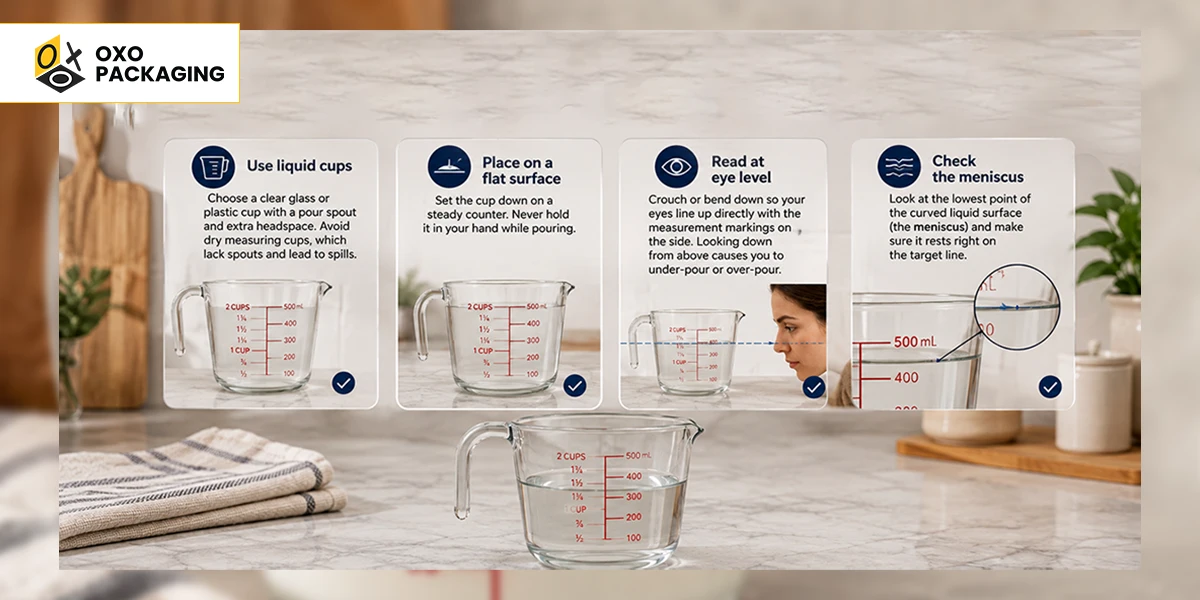
To measure liquids accurately from millilitres (mL) to cups, use a clear liquid measuring cup on a flat surface, bend down to read the bottom of the liquid curve (the meniscus) at eye level, and use standard conversions where 1 US cup equals roughly 240 mL (or 250 mL in metric recipes). Have a look below:
- Use liquid cups: Choose a clear glass or plastic cup with a pour spout and extra headspace. Avoid dry measuring cups, which lack spouts and lead to spills.
- Place on a flat surface: Set the cup down on a steady counter. Never hold it in your hand while pouring.
- Read at eye level: Crouch or bend down so your eyes line up directly with the measurement markings on the side. Looking down from above causes you to under-pour or over-pour.
- Check the meniscus: Look at the lowest point of the curved liquid surface (the meniscus) and make sure it rests right on the target line.
Avoid Common Mistakes While Converting
- Do not assume all cups are equal. A U.S. customary cup is 240 mL, a metric cup is 250 mL, and a UK/Imperial cup is 284 mL. Check your recipe’s origin.
- Millilitres measure volume, while grams measure mass. They are only equal for pure water under normal conditions, not for flour, sugar, or thick oils.
- Do not use dry measuring cups for liquids or liquid measuring cups for dry ingredients. Liquid cups have a pour spout and extra headroom to prevent spills.
- Avoid rough mental estimates on large recipes, and keep decimal accuracy when scaling numbers up to prevent compounding errors.
- Always bend down to check liquid levels at eye level. Looking down from above skews the line of sight and adds parallax error.
To Sum Up!
Since you have explored in detail how to convert mL to cups, it’s time to utilise conversions to accurately measure your products. In case you have any further queries, contact the expert team at OXO Packaging!
To convert millilitres (mL) to cups, divide your number by 237 for US customary cups, or by 250 for metric cups (used in places like Australia and New Zealand).
One cup usually contains 236.588 millilitres. However, one metric cup is exactly 250 mL in Australia.
Yes, 250 mL is exactly equal to 1 metric cup. It is usually considered the international standard. However, regional cup definitions vary globally.
No, 100 ml is not equal to 1/4 cup. Instead, 100 ml is equal to nearly 1/2 cup (specifically, about 0.42 cups). A standard 1/4 cup actually holds roughly 50 ml to 60 ml of liquid.