

Learn the Simple Guide on Converting Millilitres to Ounces
2026-08-21 12:13:23
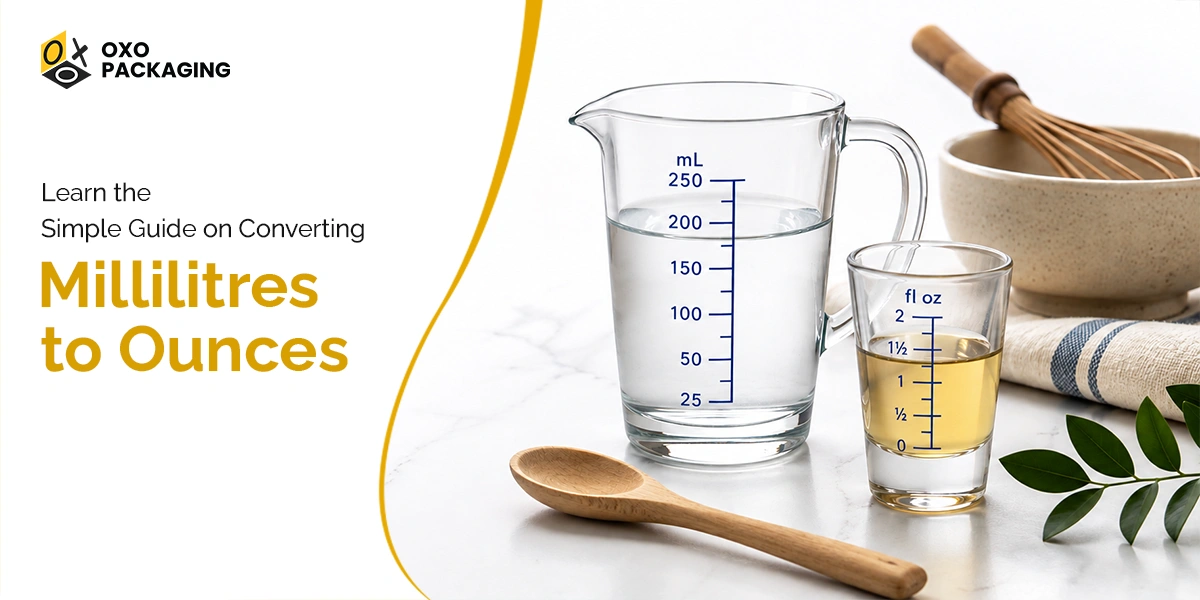
We eat, drink, and use multiple items daily, but behind them there’s always a formulation that determines their making process. The final product comes into existence when the right amount of ingredients is poured and used. Here in this blog, we’ll discuss how to convert millilitres to ounces so you can never go with a doubtful approach for your recipes. So, let’s read on.
What is ML & oz?
The mL stands for millilitre, which is a metric unit of liquid volume. It’s widely used to measure the liquid-based content and describe the actual portion of an ingredient or finished product. While the oz is the abbreviation for liquid ounce, which is also used to measure the weight or fluid volume.
Formula to Convert mL to oz
You only need a single formula for the conversion of millilitres to ounces. To perform the conversion, just divide the volume value by 29.574
- 1 mL = 0.033814 fl oz
Understand the Dual Meaning of Ounce Before Conversion
Since an ounce is widely used in the system, it’s also used to measure the solid-based content. For instance, an ounce of grains isn’t the same as an ounce of juice. The difference indicates that there is something separate between the two scales. So, if it’s about the dry content (mass), the measurement will be taken with a different approach.
Converting Millilitres to Ounces Conversion Table
If you’re in a hurry and don’t want to open the calculator to know the exact quantity of the volume, follow the chart below as a quick solution:
|
|
|
|
|
|
|
|
|
|
|
|
|
|
|
|
|
|
|
|
|
|
|
|
|
|
|
|
|
|
|
|
|
|
|
|
|
|
|
|
|
|
|
|
|
|
|
|
|
|
|
|
|
|
|
|
|
|
|
|
|
|
|
|
|
|
|
|
|
|
|
|
|
|
|
|
|
|
|
|
|
|
|
|
|
|
|
|
|
|
|
|
|
|
|
|
|
|
|
|
|
|
|
|
|
|
|
|
|
|
|
|
|
|
|
|
|
|
|
|
|
|
|
|
|
|
|
|
|
|
|
|
|
|
|
|
|
|
|
|
|
|
|
|
|
|
|
|
|
|
|
|
|
|
|
|
|
|
|
Why Do We Need to Convert Millilitres to Ounces?
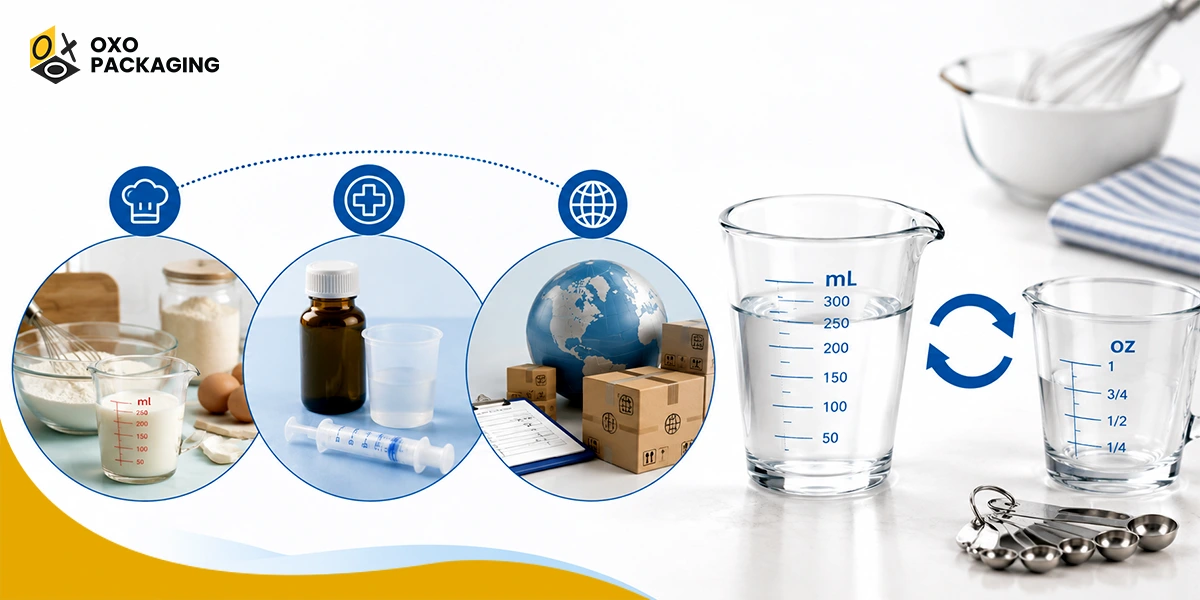
The demand to convert mL to oz isn’t just for the sake of conversions itself. But there’s always a reason that tells us the need for it. Some of the purposes for this can be:
- Alignment with the global recipes to stay on one page for cooking instructions. It helps the cooks to quickly add the exact ingredient amount without guessing about the pouring units.
- Medical dose measurements, as some medications must be given in ounces rather than millilitres.
- Product sourcing from international vendors to match the exact order size. This can save a lot of time and minimise the risks of later disputes.
The Bottom Line
All in all, we hope that you now know you can easily convert the millilitres to ounces without any issue. If you demand custom packaging in the same sizes, you can contact OXO Packaging Australia, and we’ve got you covered with tailored solutions. Reach out to us anytime by calling us at (02) 7228 8555 or writing your query to sales@oxopackaging.com.au for a detailed response.
There’s no tool or technique required to perform this task. If you have the volume of the liquid in mL, then just divide it with the value by 29.574, and you’ll get the detailed answer.
Usually up to 2 decimals of the fluid ounces are enough to consider. If someone demands more accurate calculations, then up to four decimals offer more precise results.
For most standard-sized cans, they contain around 12 fluid ounces, which is approx. 350 mLs While some brands also offer 250 mL-sized cans, which calculates around 8.45 oz.
An ounce equals around 29.57 mL, or it can be mentioned as 30 mL for ease of understanding. For the British Imperial fluid ounce calculation method, it translates into 28.41 mL.