



You might consider flyers and brochures as essential marketing materials to advertise your offerings and raise your brand awareness. That’s true, but there are more things to explore about them. Since their core aims are informing and engaging audiences while driving action. But flyers and brochures are different.
The main difference is brochure offers detailed and multipanel information about your service or brand. However, a flyer is a single sheet used for simple promotions for events or sales. This difference revolves directly around one main factor: size. Let’s dive into the complete guide to brochure and flyer sizes!
When Do You Need a Brochure?
Before diving right into brochure and flyer sizes, it is important to consider the differences between brochures and flyers. Let’s say you run a corporate business! If you want to market your brand to the target audience, you should know which one to use.
A brochure serves better if your business wants to convey more information about your service or product. Talking about its design, the brochure has folds, while the flyer does not. Though you can fold a flyer. But fold is not part of the flyer’s design.
Brochures have different types of folds that reflect different feels. So you can fold a brochure in many different ways. Keep in mind, the best brochure fold depends on its size and design. Here are the commonly used fold types of brochure:
- Trifold
- Half-fold
- Gate fold
- Double gate fold
- Parallel fold
- Z-fold
- Accordion fold
- Roll fold
Explore Standard Sizes of Brochures
Wondering how big or small a brochure is? Well, there are multiple types of standard sizes for brochures. Consider the most common sizes for brochures, whether folded or opened:
- Letter size: 21.59 x 27.94 cm
- DIN A4: 21.0 x 29.7 cm
- Legal size: 21.6 x 35.6 cm
- Memo size: 14 x 21.6 cm
- Tabloid size: 28 x 43.2 cm
Out of the above sizes, letter-size paper is the most common. This paper has a half-fold and tri-fold style. If you print a tri-fold brochure on the same standard letter-size paper, each side will measure 21.59 x 27.94 cm. However, this brochure will have dimensions 21.59 x 9.4 cm after you fold the paper.
And when each side of a half-fold brochure is printed on standard letter-size paper, it will measure 21.59 x 14 cm after folding.
When Do You Need a Flyer?
Flyers come into use when your business has little information to convey. It is suitable to use when you need to announce a sale, an upcoming event, and your business launch. You can also leverage flyers to get the conversation between you and your customers with a fact sheet about your product.
Plus, a flyer is used to advertise you, what you do, and what you are promoting at the moment. Use flyers to announce grand openings, seasonal deals, community involvement, and job openings. Or to provide discount vouchers, ensuring they have a clear headline, concise info, and a strong call-to-action.
Explore Standard Sizes and Uses of Flyers
The standard size of a flyer is the same as a piece of computer paper. Its size is very similar to the universal A4 size, that is, 21 x 29.7 cm. However, flyers are popular due to the smaller format sizes, like:
- Letter size: 22 x 28 cm
- A4: 21 x 29.7 cm
- A5: 15 x 21 cm
- A6: 10.5 x 14.8 cm
- DL: 9.9 x 21 cm or one third of A4
If you are thinking which flyer size to opt for, it depends on where and how you want to distribute your flyers. Let’s say if you want to stick your flyers to walls or convey massive information, go with letter size or A4. But if you want to post your flyers, you should pick an A6 or DL size that seamlessly fits into a standard envelope.
When to Choose a Brochure Over a Flyer?
Plan to print a brochure rather than a flyer because you have more information to convey. Going with printing a brochure will be suitable when you have to nurture on connections you have already made. Either want to educate an engaged audience about your product or need to have reference materials on hand.
Apart from this, you can use both flyers and brochures in the same funnel. Let’s say you have a pique interest in a trade show after handing over flyers with an amazing list of everything that makes your product amazing.
Now, you would like to give more details to people, then you can leverage a brochure. Doing so can help you get more sales, booking consultations or anything you want them to do with additional information provided on the brochure.
Factors to Consider in Flyer and Brochure Design
The size and design of your flyers or brochures must align with their purpose. To understand this purpose, consider the following key factors:
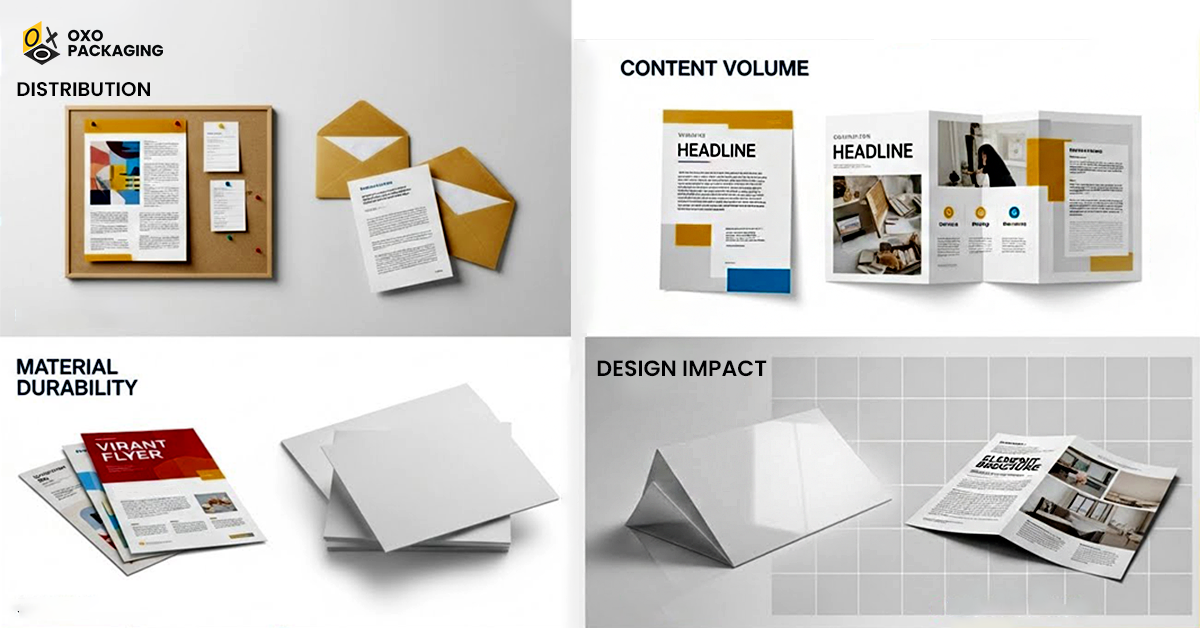
Distribution Method
For bulletin boards, your flyers must be larger for maximum visibility. For mailing, your brochures must need to fit the dimensions of a standard envelope. For posting invitations, pick a DL-sized flyer or a tri-fold brochure, ensuring they fit snugly in standard envelopes.
Content Volume
Want to convey concise messages? Fyers are best. But in the case of providing in-depth information. Brochures are perfect. For example, if you run a luxury spa, then you should choose a brochure to incorporate sections on services, pricing, and client testimonials.
Material Durability
When it comes to choosing materials, go with lightweight paper for short-term flyers. However, use high-quality coated materials for long-term brochures. For a financial consultancy, a brochure made from heavyweight paper with a glossy, premium feel is good to go.
Design Impact
To grab attention quickly, use bold designs on flyers. However, leave sufficient space on brochures for refined layouts. In the case of a boutique store, you can use vibrant colours and bold fonts on a flyer, while curated styling guides on a brochure for seasonal collections.
How to Choose the Right Flyer or Brochure Size?
To choose the right flyer or brochure size, define your purpose and content (detailed vs. quick info), consider distribution (handouts, mail, racks), audience interaction, and budget. Then, match it to standard sizes like A4 or Letter (detailed), A5 (compact), or Postcard (displays) for maximum impact and cost-efficiency.
Which One Suits Your Business: Brochure or Flyer?
Well, the selection between a flyer or brochure depends upon multiple factors such as the brand's marketing goals, available budget, and the content they want to communicate. If you evaluate both options on what features they offer, flyers are good to distribute to a large-scale audience, even if they're not interested in your offering.
Whereas a brochure should be given to those who are more inclined towards your products and services. This triggers them to build a relationship with the brand and stay in their memory for a long time. Both are great marketing tools in their domain, but the intent of the business determines whether they go with an eye-catching flyer or an extensive brochure.
To minimize your confusion on this, it's better to consult with an expert and tell them your whole scenario. After understanding your business's target audience, they'll help you with the selection of what fits perfectly for you.
To Sum It Up
Once you go through the complete guide to brochure and flyer sizes, your business will be able to make informed choices for your marketing materials. In crux, flyers are a good choice for conveying short and impactful messages, and brochures for detailed information.
Analyse your goals, content, and distribution method to choose the size and material that best meet your business needs. Are you ready to design impactful marketing materials?
OXO Packaging specialises in custom flyer and brochure design. We offer professional solutions for your digital print business and help your brand leave a lasting impression.
Brochure and flyer sizes vary. But common sizes are Letter (8.5"x11") and Half-Letter (5.5"x8.5"). However, international standards use A4 (210x297mm) and A5 (148x210mm), with DL (99x210mm) popular for mailers.
Australian flyers come in standard A-series sizes like A4, A5, A6, and the popular DL (one-third A4). The dimensions vary from small, hand-out sizes like A6 (105x148mm) to larger ones for posters like A3 (297x420mm).
The most recommended flyer sizes are the standard US Letter (8.5" x 11") and the international A4 (8.3" x 11.7") for versatility. But smaller sizes like A5 (5.8" x 8.3") or Half Sheet (8.5" x 5.5") are great for direct mail or coupons.
Neither A5 nor A6 is inherently better. It depends on your goals. For example, A6 (postcard size) is great for quick, high-volume handouts, direct mail, or simple coupons due to its portability and lower cost. However, A5 size offers more space for detailed info, images, menus, or event schedules, making it ideal for something to be kept longer or displayed.