


Plastic pollution is pushing businesses and consumers to look for eco-friendly packaging alternatives. Among many alternatives, Polylactic Acid (PLA) is a material that has gained popularity in recent years.
PLA comes from renewable resources like corn starch and sugarcane. It offers a biodegradable and compostable solution for packaging needs. And the best part? PLA doesn’t compromise on functionality either.
Read this blog to learn more about PLA in detail. You’ll get to know about PLA benefits, challenges, applications, and future trends in the packaging industry.
What is PLA (Polylactic Acid)?
Put simply, polylactic acid (PLA) is a biodegradable and bio-based thermoplastic polymer made from renewable resources such as corn starch, sugarcane, and cassava. Unlike traditional petroleum-based plastics, PLA is compostable and reduces the carbon footprint of packaging applications.
How PLA Is Manufactured?
Polylactic acid (PLA) is produced through the bacterial fermentation of plant-based carbohydrate sources (raw materials such as corn starch, sugarcane, and cassava) into lactic acid. Afterwards, lactic acid is polymerised to create PLA.
Types of Polylactic Acid (PLA)
Since PLA is made from lactic acid, there are several types of polylactic acid:
- Poly-L-lactide (PLLA): originates from the polymerisation of L-lactide. It is also known as L-lactide.
- Carbon Fibre PLA: blends PLA with carbon fibre, which results in a stronger and more rigid filament.
- Blended PLA: PLA is mixed with other polymers to enhance properties and applications. Some common types are wood PLA and metal PLA.
Pros and Cons of PLA in Packaging Industry
PLA has its own pros and cons in the packaging industry. Exploring them will help businesses to drive insights whether they should choose PLA or not as their packaging material.
Pros of PLA
Polylactic acid is a superbly eco-friendly and sustainable packaging material. But it has also diverse benefits:
Polylactic Acid Biodegradable
Polylactic acid is 100% biodegradable and compostable, meaning it breaks down into natural components like water and carbon dioxide under industrial composting conditions. This makes it an excellent alternative to conventional plastics that take hundreds of years to decompose.
Reduced Carbon Footprint
Since PLA is derived from renewable agricultural sources, its production emits significantly lower greenhouse gases compared to petroleum-based plastics. According to research, PLA generates 65% fewer carbon emissions than traditional plastics, making it a climate-friendly choice for packaging manufacturers.
Versatility and Adaptability
PLA can be customised into various shapes and styles, making it suitable for a wide range of packaging applications such as food containers, beverage bottles, films, and wraps. Its transparency and durability allow it to replace materials like PET (polyethylene terephthalate) in many use cases.
Food Safety and Non-Toxicity
Polylactic acid is a toxin-free material for food contact applications, ensuring that it is safe for packaging food and beverages. Unlike some petroleum-based plastics, it does not release harmful chemicals like bisphenol A (BPA) or phthalates, making it a healthier choice for consumers.
Compostability and Waste Reduction
One of the major advantages of PLA is that it can be composted in industrial facilities. Hence, it breaks down into organic matter within three to six months. This helps reduce plastic waste and promotes a circular economy where packaging materials return to nature rather than polluting landfills and oceans.
Cons of Using PLA in Packaging
Despite its many benefits, PLA also has some cons that need to be addressed for wider adoption in the packaging industry.
Composting Limitations
While PLA is compostable, it requires specific industrial composting conditions (high temperatures and humidity) to break down effectively. It does not degrade efficiently in household compost bins or landfill environments, leading to potential disposal issues.
Cost and Production Limitations
Compared to conventional plastic pouches, PLA is currently more expensive to produce due to the cost of raw materials and the polymerisation process. However, with increased demand and technological advancements, production costs are expected to decline over time.
Heat Sensitivity
PLA has a lower melting point than traditional plastics, making it unsuitable for high-temperature applications. For example, PLA-based food containers may deform or lose their integrity when exposed to high heat.
Recycling Challenges
A question arises in the marketing industry: is PLA recyclable? Well, PLA is recyclable, but it is not widely accepted in conventional recycling streams. Because it requires separate processing facilities. If mixed with regular plastic waste, it can contaminate recycling batches, leading to inefficiencies in waste management systems.
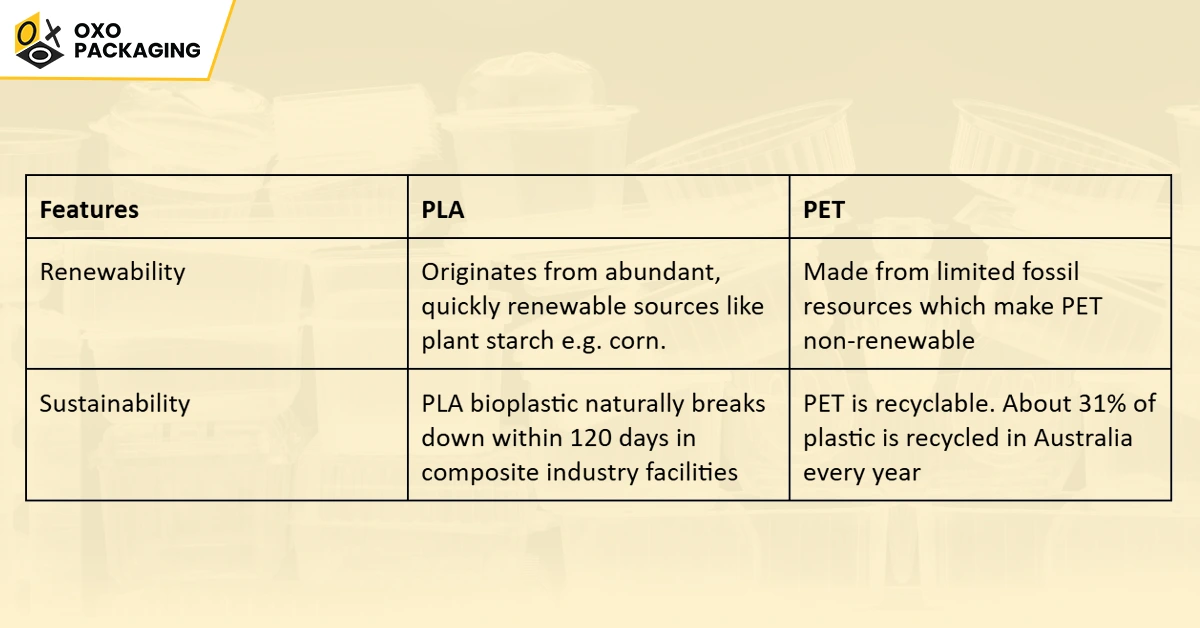
Polylactic Plastic vs PET
As a business owner, you must know the basic difference between polylactic acid (PLA) and traditional polyethylene terephthalate (PET). Consider the comparative overview of PLA vs PET to understand which one is better in business interest:
Pros and Cons of PLA at a Glance
|
Pros |
Cons |
|
Eco-Friendly and Bio-based: Made from renewable resources like corn starch or sugarcane, reducing reliance on fossil fuels. |
Industrial Composting Required: Does not break down quickly in regular landfills or home composts; needs high-heat industrial facilities. |
|
Lower Carbon Footprint: Production generates fewer greenhouse gas emissions compared to traditional petroleum-based plastics. |
Low Thermal Resistance: Distorts and melts at relatively low temperatures (around 50-60°C / 120-140°F), making it unsuitable for hot foods or liquids. |
|
High Clarity and Gloss: Offers excellent transparency, making it visually appealing for food displays and clear containers. |
Brittleness: Can be fragile and crack easily under pressure unless blended with other polymers. |
|
Excellent Aroma Barrier: Helps retain flavours and scents, which is ideal for certain food packaging applications. |
Poor Moisture and Gas Barrier: High permeability to water vapour and oxygen, reducing the shelf life of perishable goods. |
|
FDA Approved: Generally Recognised As Safe (GRAS) for direct food contact. |
Recycling Contamination: Looks identical to PET (plastic #1) but ruins the recycling stream if mixed into traditional plastic bins. |
Is PLA Environmentally Friendly?
PLA is partially eco-friendly due to its plant-based origins. However, its real-world environmental impact is complex.
Why PLA is Considered Eco-Friendly?
PLA is derived from renewable crops like corn starch, sugarcane, or cassava rather than fossil fuels. Producing PLA generally uses less energy and emits fewer greenhouse gases than making traditional petroleum-based plastics like ABS or PET. In its pure form, PLA is non-toxic and biocompatible.
Where PLA Falls Short?
PLA does not break down easily in home compost piles, natural soil, or oceans. It requires high temperatures around 60°C to 70°C and specific microbes found strictly in commercial or industrial composting facilities.
If thrown into regular trash or a standard landfill, PLA can last for decades or even centuries, sometimes releasing methane as it slowly degrades. PLA cannot be melted down with traditional plastics (like PET or HDPE) and can ruin recycling batches if mixed in.
Growing the crops needed for PLA requires land, water, and often fertilisers or pesticides, which carry their own environmental costs. Many commercial PLA products or 3D printing filaments contain colourants, stabilisers, or additives that further slow down or prevent proper decomposition.
Uses of PLA in Packaging Industries
The packaging industry has embraced PLA in various sectors due to its eco-friendly properties and functional advantages. Here are some key uses:
Food Packaging
PLA is widely used in food packaging applications such as clamshell containers, trays, cups, and cutlery. It provides an excellent oxygen barrier, helping to maintain food freshness. Being biodegradable, it is ideal for single-use food service packaging.
Beverage Bottles
PLA-based bottles are an alternative to PET bottles for water, juice boxes, and dairy products. They offer transparency and durability similar to traditional plastic bottles.
Flexible Packaging Films
PLA films are used for wrapping snacks, baked goods, and fresh produce. They provide moisture resistance and good printability for branding and labelling purposes.
E-Commerce and Retail Packaging
PLA-based mailers, pouches, and shopping bags offer sustainable alternatives for online retailers. Many brands are adopting PLA-based materials to align with their sustainability goals.
Common Packaging Products Made from PLA
|
Category |
Products |
|
Cold Beverage Cups and Lids |
Clear cups for iced coffee, cold drinks, smoothies, and matching transparent or compostable lids. |
|
Food Containers and Trays |
Salad bowls, deli containers, fruit and vegetable trays, and clamshell takeout boxes. |
|
Bottles |
Short-term shelf-life bottles for water, juices, and dairy or fermented drinks. |
|
Biodegradable Films and Wraps |
Overwrap films for fresh produce, snack bags, tea bags, and lamination layers on paper or cardboard food containers. |
|
Cutlery and Utensils |
Single-use forks, spoons, and knives for food service. |
|
Blister Packs |
Clear protective packaging for retail or consumer goods. |
When PLA Packaging is Right for Your Business?
PLA is a great fit if your business handles cold or room-temperature items, prioritises plant-based or renewable materials, and operates in an area with access to commercial composting, such as:
- Cold Food and Beverage Service: Ideal for cold-brew coffee cups, juice cups, salad containers, cold-cut trays, and bakery clamshells.
- High-Clarity Requirements: Works well if you need a crystal-clear, transparent look similar to traditional PET plastic to showcase your products.
- Access to Industrial Composting: Best if your local supply chain or municipal waste system supports commercial composting facilities (where PLA breaks down in 90–180 days).
- Sustainability Branding: Helps reduce reliance on petroleum-based polymers and lowers the carbon footprint of your initial manufacturing phase.
When PLA Packaging is the Wrong Choice?
PLA is not right for hot foods, standard plastic recycling streams, or general landfills. Look below for when you should avoid using it:
- Hot Foods or Microwaving: Pure PLA softens and deforms at temperatures above 110°F to 131°F (43°C to 55°C), making it unsuitable for hot soups, hot coffee, or microwave heating.
- Standard Curbside Recycling: PLA cannot be recycled with regular petroleum plastics (like PET or HDPE) and will contaminate recycling batches if mixed in.
- Backyard Composting or Landfills: PLA does not break down in home compost bins or regular landfills; it requires controlled industrial heat and microbes.
- Strict Cost Optimisation: PLA-lined or PLA-based items typically carry a higher unit cost than standard petroleum-based or PE-lined alternatives.
Future of PLA in Packaging
The global trend for sustainable packaging solutions is driving research and innovation in PLA-based materials. Some future trends include:
Advancements in PLA Blends
To overcome PLA’s limitations, scientists are developing blends with other biopolymers like polyhydroxyalkanoates (PHA) to improve mechanical strength, heat resistance, and decomposition rates.
Expansion of Composting Infrastructure
As the adoption of PLA grows, governments and industries are investing in industrial composting facilities to handle PLA waste effectively. Improved composting networks will enhance PLA’s viability as a sustainable alternative.
Cost Reduction Through Mass Production
With increased demand and production scalability, the cost of PLA is expected to decrease, making it more competitive with traditional plastics.
Enhanced Recycling Technologies
Innovative chemical recycling methods are being developed to convert PLA waste back into lactic acid monomers for reuse in new products, promoting a circular economy.
While challenges such as composting limitations and cost constraints exist, advancements in material science and waste management are paving the way for wider adoption.
Conclusion
Polylactic Acid is a desirable packaging solution. It is revolutionising the packaging industry because of its sustainability characteristics. Businesses and consumers are adopting PLA packaging for the benefits it offers.
As a brand, you can boost revenue by adopting eco-conscious packaging solutions. You’ll be able to attract more consumers with eco-friendly packaging. Contact us today to get a free sustainable packaging quote for your business needs.
PLA stands for Polylactic Acid, a biodegradable plastic made from renewable resources like corn starch, sugarcane, or cassava. It is widely used as a sustainable alternative to traditional petroleum-based plastics.
Yes. PLA is biodegradable and compostable under industrial composting conditions, typically breaking down within 3 to 6 months. However, it may not degrade effectively in home compost or landfill environments.
PLA is used to make:
- Food containers & clamshells
- Cups & lids
- Bottles
- Clear bags & films
- Straws
- Cutlery
Its transparency and durability make it popular for food-safe and eco-friendly packaging.
- Made from renewable resources
- Biodegradable & compostable (industrial compost)
- Reduces carbon footprint compared to traditional plastics
- Safe for food contact
- Offers clarity and rigidity similar to PET plastic
PLA has low heat resistance, softening at around 50°C to 60°C (122°F to 140°F). It is not suitable for microwaving or high-heat applications.
Yes. PLA is certified food-safe for cold and room-temperature food applications, commonly used for salad containers, cups, and takeaway boxes.
PLA combines eco-friendliness, renewable sourcing, and functional properties, making it an attractive solution for brands aiming to reduce their environmental impact and meet consumer demand for sustainable products.