


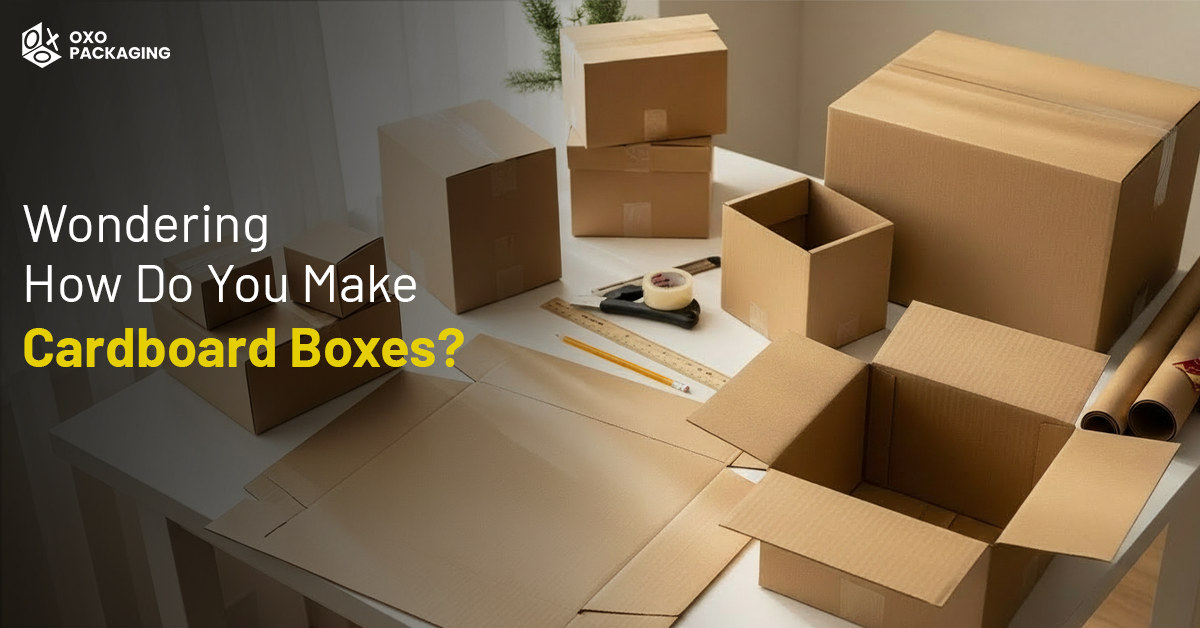
Tired of spending extra money on pre-built boxes? Well, you are at the right place to learn how to make DIY boxes. The best material for DIY boxes is cardboard due to its high durability, wear and tear resistance, cost-effectiveness, and eco-friendly nature.
Whether you are shipping Christmas gifts or replacing an old game board box, craft cardboard boxes. With flexible customizability, you can assemble and cut these boxes to the perfect size. Explore in this blog about how do you make cardboard boxes while saving significant money. Read on!
A Step-By-Step Guide to Make Cardboard Boxes
Let’s dive directly into how do you make cardboard boxes without any further delay. Consider these step-by-step instructions to make cardboard boxes while maintaining integrity and quality:

Plan Dimensions for Your Cardboard Sheet
Firstly, pick a flat sheet of cardboard. Then, find the required internal dimensions before the external dimensions. Calculate these dimensions based on the thickness of the chosen cardboard material. You need to follow a standard format for measuring these dimensions in order of Length x Width x Height (L x W x H).
Decorate the Chosen Cardboard
Before cutting and folding your cardboard box, you can easily decorate it if you want an embellished look. To decorate your cardboard box, pick a piece of wrapping paper that’s about ½ inch larger than the cardboard on all sides. Then, utilize strong glue to bind wrapping paper onto cardboard. Finally, fold the cardboard over the corners of the decorative wrapping paper while binding them onto the other side.
Mark the Edges of the Cardboard
After gluing wrapping paper onto cardboard, draw a line close to one corner of the cardboard. As a result, it forms a small “glue flap.” Later, you can fold it over and secure it with a binding to keep the four sides together. Keep the width of the glue flap to 2 inches if you are crafting a large shipping box. However, you can also keep its width at ¼ inch for a small art project.
Cut the Cardboard into Four Sections
Once you decide on the width of your cardboard box, take a ruler to measure the length. Mark your box at each ¼ of the length. Afterwards, utilize a scale as a straightedge to draw parallel lines through these marks. Doing so will cut the cardboard into four equal sections and form the four sides of the box.
Score the Lines
In the next step, place the ruler along the drawn lines in the 4th step. Then, press them to make them easier to fold. You can also use a sharp knife for thicker cardboard material, such as corrugated cardboard, using only light pressure. Either utilize a bone folder or an empty ballpoint for medium-weight cardboard material such as posterboard.
Bend the Sides of the Box
Finally, fold these sides inward from both ends to form a stack. Then, unfold them. Doing so creases the paper for easy folding later. Also, bend the thick material so the cut score is on the outer side of the box. Similarly, you can bend posterboard or any other medium-weight cardboard material.
Draw the Flaps
To draw the flaps perpendicular to the bent sides, ensure you divide the length of one cardboard box by two. Measure the distance between the two lines from one edge of the cardboard. Then, draw a line width-wise at this point, which runs across the lines you bent in the earlier step. Measure this distance starting from opposite corners. And draw a second line.
Cut Each Flap
Cut along the lines you marked for the flaps in the 7th step. The cutting method for lines needs a strategic method. Following this method, you should cut along the vertical side until you hit the horizontal flap lines. It will lead to four flaps along the top and four along the bottom of the box.
Fold and Assemble Four Sides
In this step, bend the four flaps to form the basic structure of a cardboard carry box. Then, fold the narrow glue flap over the corner of the side. And tape or glue it down based on your ease. Ensure you are applying glue onto a dry surface where no moisture exists. You can also use a fan or a hair dryer to make the glue dry faster.
Fold the Bottom of the Box
Fold the flaps on one side together. It results in each flap overlapping another flap next to it. Strengthen these flaps of the bottom boxes with tape. Keep in mind that if you are placing lightweight items, you just need to close the flaps together without folding them into place. Then, bind this simple fold with tape inward and outward to prevent flaps from protruding.
Tuck Flaps on Top Together
In the last step, pick a tape to close the top of the box if you are making a cardboard gift box. Or if you have placed some item inside a box for shipping. Otherwise, just leave the top tucked together for easy access and opening.
Ta Da: You Have Made a Cardboard Box?
Congratulations, you have made a cardboard box following the above instructions step-by-step. Keep in mind that if you want to place delicate items in cardboard boxes, you must place bubble wrap inside them. Otherwise, your fragile items like glass bottles may break during shipping.
By implementing the above steps, you can save money using minimal tape and strong glue. But in case you want to avoid the hassle of DIY cardboard box making, contact OXO Packaging to enjoy a premium-quality box at a competitive price.
Simply, cut and fold a piece of cardboard by scoring a base rectangle. Then, add four sides with tabs that fold up and glue together to form a square cardboard box.
You can attach two pieces of cardboard by using glue, tape, or a tab-and-slot method. For a strong hold, hot glue is effective, while duct tape is a simple option for a quick connection.
Apply a wax coating by dipping it in melted wax or brushing it on, or use waterproof sprays for a fast, convenient solution to make cardboard strong and waterproof.
Apply several techniques that focus on lamination, internal reinforcement, strong joints, and structural design to make cardboard structurally stronger.